Trending peptide
Sermorelin
Also called Sermorelin acetate, GHRH(1-29)-NH2, GRF(1-29)-NH2, hGRF(1-29)-NH2, Geref (former US brand, withdrawn).
Sermorelin is a lab-made copy of the first 29 building blocks of a natural brain hormone that tells the pituitary gland to release growth hormone. The US once approved it as a test and for children with low growth hormone. The maker stopped selling it, and both US approvals were withdrawn in 2009. FDA said this was not for safety reasons.
Sermorelin is not an approved medicine for these uses in most countries. This page explains the science and the law; it does not give dosing, sourcing or usage advice.
How strong is the evidence?
Last verified 2026-09-29 · how we verify
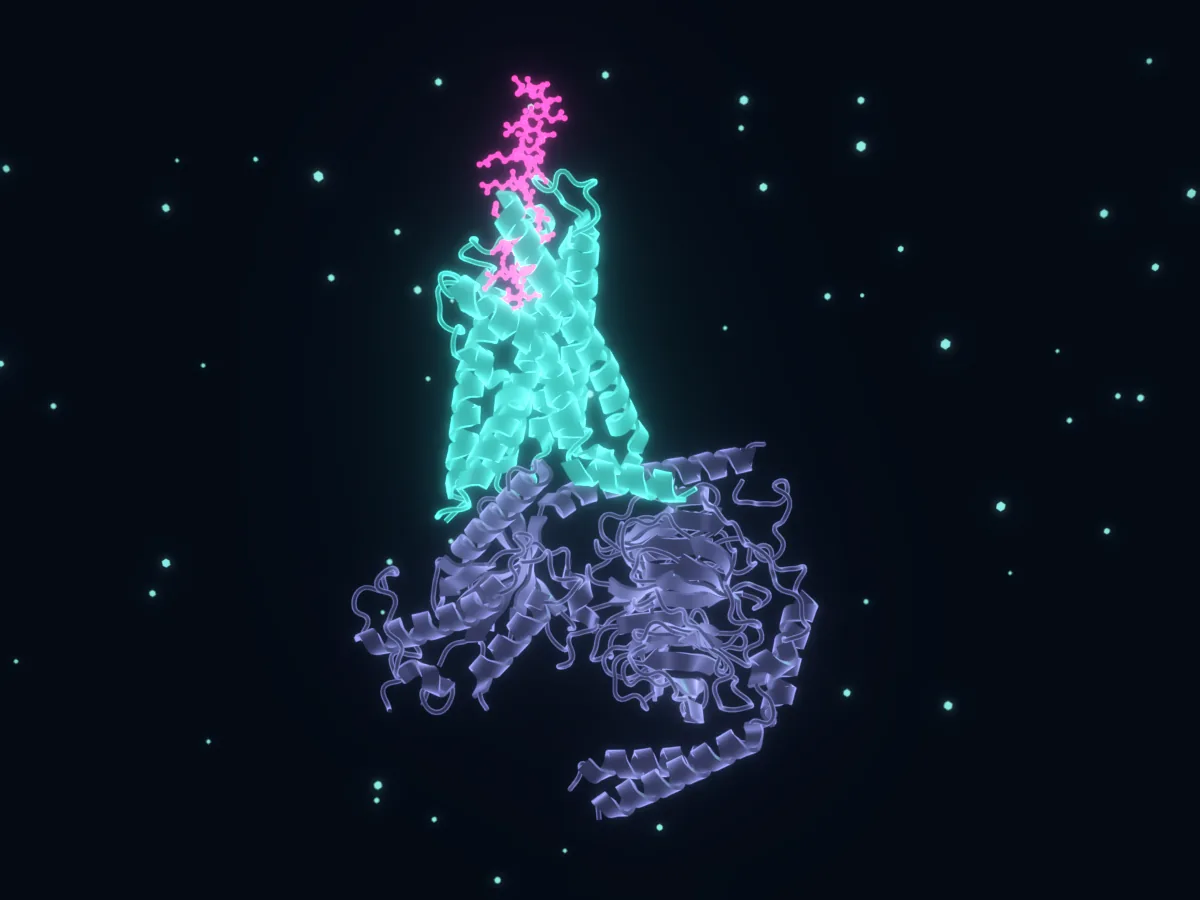
Experimental structure · cryo-EM 2.6 Å · PDB 7CZ5 (2020)RCSB entry ↗
Not Sermorelin itself. No structure of Sermorelin bound to its receptor has been published, so a related structure is shown for context.
The body's own growth hormone-releasing hormone (GHRH, 44 residues) at its receptor. No tesamorelin- or sermorelin-bound structure was found in the PDB (RCSB search, 2026-09-29); shown for context only. Palmitic acid, cholesterol and nanobody Nb35 (chain N) omitted. Structure from Zhou et al., Nat Commun 2020. Colours are ours, not the molecule's.
- Acts on
- Growth hormone-releasing hormone (GHRH) receptor on pituitary somatotroph cells
- Taken as
- When it was FDA-approved (Geref), it was given by injection: as a single intravenous test to check pituitary growth hormone reserve, and as a daily subcutaneous injection for children with idiopathic growth hormone deficiency under specialist care. It has also been studied in small trials by subcutaneous and intravenous routes and by continuous subcutaneous infusion; a nasal route was tested in healthy men and absorbed poorly (about 3 to 5% bioavailability). It is not approved for any other use.
- Half-life
- Short: about 10 to 20 minutes in humans, according to a 2003 review by Serono scientists, mostly because the kidneys filter it out and enzymes cut its front end.[src]
- FDA approvals (both withdrawn)
- NDA 19-863 (diagnostic ampules) approved 1990-12-28 and NDA 20-443 (children with idiopathic growth hormone deficiency) approved 1997-09-26; holder EMD Serono; brand Geref.[src]
- Approval withdrawn
- Approval of both NDAs was withdrawn effective 2009-06-18 after the company reported discontinuation in 2008. In 2013 FDA determined the products were not withdrawn from sale for reasons of safety or effectiveness.[src]
- Paediatric trial result
- In 110 previously untreated GH-deficient children (86 evaluable), height velocity rose from 4.1 to 8.0 cm/yr at 6 months and 7.2 cm/yr at 12 months; 74% were good responders at 6 months (open-label, no control group).[src]
Inside the body
What Sermorelin does, step by step
- 01Skin
Given by injection
When doctors used sermorelin, it was injected: into a vein for a one-off test, or just under the skin for children's treatment.
For experts
The approved presentations were an intravenous diagnostic dose and a subcutaneous daily regimen in children. Nasal absorption is poor (bioavailability about 3 to 5% in healthy men). Human subcutaneous bioavailability is not given in the sources we reviewed; in anaesthetised rats, plasma exposure after subcutaneous injection was about 4% of that after an intravenous injection, which suggests substantial degradation at the site or during absorption (animal-only finding).[src][src][src]
- 02Bloodstream
Broken down within minutes
In studies of the body's own full-length hormone, enzymes in the blood snip the first two building blocks off the front of the chain, and that makes it almost inactive. Sermorelin has the same front end. Together with removal by the kidneys, this is why sermorelin is gone from the blood within minutes.
For experts
For human GHRH(1-44), plasma dipeptidyl-peptidase cleavage of the N-terminal Tyr-Ala gives GHRH(3-44)-NH2, which has less than 1/1000 of the activity; the in vivo half-life of GHRH(1-44) by HPLC was 6.8 min in normal subjects. Sermorelin shares the same N-terminus. A 2003 review reports its plasma half-life as roughly 10 to 20 minutes in humans, caused mostly by renal ultrafiltration and N-terminal enzymatic degradation, and an infusion study in men measured a disappearance half-time of 4.3 +/- 1.4 min (versus 6.7 +/- 0.5 min for a D-Ala2 analogue with reduced clearance).[src][src][src]
- 03Brain
Signals the pituitary gland
The pituitary is a pea-sized gland at the base of the brain. Sermorelin fits a lock (a receptor) on the pituitary cells that make growth hormone. It is the same lock the body's own hormone uses.
For experts
Sermorelin acts on the GHRH receptor, a class B GPCR that couples to Gs, on pituitary somatotrophs. The cryo-EM structure of the human receptor with Gs and full-length GHRH(1-44) (PDB 7CZ5) shows the natural ligand that sermorelin copies; sermorelin corresponds to residues 1 to 29 of that peptide. The structure is of the natural hormone, not of sermorelin.[src][src]
- 04Brain
A pulse of growth hormone is released
The pituitary answers with a burst of growth hormone. The burst lasts a few hours, even though sermorelin itself is gone in minutes.
For experts
In a study of 30 healthy men aged 19 to 43 given GHRH(1-29)-NH2 intravenously or intranasally, intravenous doses gave dose-related GH release; despite rapid elimination of the peptide, GH remained elevated for about 3 hours. In eight slowly growing children, continuous subcutaneous infusion gave sustained pulsatile GH secretion without desensitisation for up to a year; the authors took the persisting pulses as evidence that somatostatin still sets the rhythm, so the body's own brake stays active.[src][src]
- 05Liver
The body makes IGF-I
Growth hormone tells the liver and other tissues to make a helper hormone called IGF-I. IGF-I carries out much of the growth message around the body.
For experts
GH raises circulating IGF-I. In a small crossover study in 10 healthy old men, twice-daily subcutaneous GHRH(1-29) for 14 days raised mean 24-hour GH and IGF-I in a dose-related way (statistically significant only at the higher dose), and after the higher dose the values did not differ significantly from those of young men. In children treated for a year, IGF-I did not rise excessively. These are hormone markers, not proof of clinical benefit in adults.[src][src]
- 06Bone
Growth speeds up in some children
In children whose bodies make too little growth hormone, this can make them grow faster. Most children in the main study had a good response. It was not tested head-to-head against standard growth hormone.
For experts
In the open-label study of 110 previously untreated prepubertal GH-deficient children (86 evaluable), mean height velocity rose from 4.1 +/- 0.9 cm/yr to 8.0 +/- 1.5 at 6 months and 7.2 +/- 1.3 at 12 months; 74% were classed as good responders at 6 months, and bone age advanced in proportion to height age. The 1999 review notes that effects on final adult height were not established and that increases in height velocity appeared smaller than with somatropin (indirect comparison). There is no equivalent proof of effect on body composition or ageing outcomes in adults.[src][src]
For experts
The detail
Sermorelin is GHRH(1-29)-NH2, a 29-residue C-terminally amidated peptide (C149H246N44O42S, about 3358 Da) whose sequence is identical to the N-terminal 29 residues of human growth hormone-releasing hormone (GHRH 1-44); it is the shortest fragment that keeps the full biological activity of the parent hormone. It activates the GHRH receptor (a class B G protein-coupled receptor coupled to Gs) on pituitary somatotrophs, stimulating pulsatile GH release and, downstream, IGF-I, with the physiological feedback system (somatostatin) remaining in place. It has no engineered half-life extension: a Serono review attributes its short half-life mostly to renal ultrafiltration and N-terminal enzymatic degradation (plasma dipeptidyl-peptidase removal of Tyr-Ala was shown for GHRH 1-44), and its plasma half-life in humans is short, reported as about 10 to 20 minutes in a review, with a disappearance half-time of 4.3 min in an infusion study in ten men, yet GH stays raised for about 3 hours after an intravenous dose. Subcutaneous exposure was about 4% of intravenous in an anaesthetised-rat study (animal-only). Regulatory history (FDA): NDA 19-863 (diagnostic ampules, evaluation of pituitary GH secretory ability) was approved 1990-12-28 and NDA 20-443 (idiopathic GH deficiency in children with growth failure) on 1997-09-26, both held by EMD Serono. The company reported discontinuation in 2008 and requested withdrawal; approval of both NDAs was withdrawn effective 2009-06-18, and in 2013 FDA determined the products were not withdrawn for reasons of safety or effectiveness. Key evidence is an open-label, 110-child, one-year study (Geref International Study Group, 1996) and a 1999 review; mean height velocity rose from 4.1 to 8.0 cm/yr at 6 months and 7.2 cm/yr at 12 months in GH-deficient children. A 1999 review notes there was no direct comparison with somatropin, and that height-velocity gains with sermorelin given by continuous infusion or in three divided doses were smaller than with daily somatropin in other children; effect on final adult height was not established. Use in healthy adults, or for anti-ageing or body-composition aims, is unapproved and rests on small, short human studies. Compounding and country-by-country legal status are covered in the status records, not here.
Evidence: Sermorelin has real human clinical data, but no current marketing authorisation. The best data are one open-label, uncontrolled 12-month study of 110 previously untreated children with growth hormone deficiency (Geref International Study Group, 1996), earlier small paediatric studies (for example, eight children in a 1990 continuous-infusion study), and a 1999 review that supported the former US approvals. In adults there are only small, short studies, such as a two-week crossover in old men that raised GH and IGF-I. No large randomised trial shows benefit for healthy adults, and none of the studies we reviewed reports final adult height; the 1999 review notes only a few children followed for up to 36 months. Its FDA approvals (1990 and 1997) were withdrawn in 2009 after the company stopped selling it.[src][src][src][src][src]
Known safety signals
- In clinical use in children and as a diagnostic test, sermorelin was reported to be well tolerated; transient facial flushing and pain at the injection site were the most commonly reported adverse events.[src]
- In the 110-child one-year study, no adverse changes in general biochemical or hormonal tests were noted, there was no change in fasting glucose, and IGF-I did not rise excessively.[src]
- Evidence in adults is small and short: in a 14-day crossover in old men, GHRH(1-29) did not change fasting glucose, urinary C-peptide, blood pressure, or chemistry and haematology profiles. Longer-term safety in healthy adults has not been established by the studies we reviewed.[src]
- FDA determined in 2013 that Geref was not withdrawn from sale for reasons of safety or effectiveness; the withdrawal followed the manufacturer's decision to discontinue the product.[src]
- Sermorelin is not named on FDA's page of bulk substances that may present significant safety risks. For other peptides on that page, FDA cites immunogenicity from aggregation and peptide-related impurities as concerns, so the quality of unregulated or compounded peptide products is a general open question rather than a sermorelin-specific finding.[src]
Around the world
Is Sermorelin legal where you live?
| Country | Status | What it means | Verified |
|---|---|---|---|
| Australia | Not approved | Not on the ARTG. Sermorelin is prescription-only (Schedule 4), and as a GHRH analogue it may also fall under the Appendix D possession control.Details →source | 2026-09-29 |
| Brazil | Not approved | No Brazilian registration for sermorelin; the unregistered-peptide rules applyDetails →source | 2026-09-29 |
| Canada | Prohibited | Not authorised; named in Health Canada's 2025 Canada Peptide seizure notice and banned in sportDetails →source | 2026-09-29 |
| China | Not approved | No NMPA approval found for sermorelin; it cannot lawfully be sold as a medicine in China and is banned in sport.Details →source | 2026-09-29 |
| European Union | Not approved | No EU marketing authorisation; banned in sport (WADA S2.2.4)Details →source | 2026-09-29 |
| India | Not approved | Not approved in India: no CDSCO marketing permission found for Sermorelin; making or selling it as a medicine would be unapprovedDetails →source | 2026-09-29 |
| Japan | Not approved | Not an approved medicine in Japan; sermorelin is absent from PMDA's lists, and WADA bans it in sportDetails →source | 2026-09-29 |
| Mexico | Not approved | No current registration for sermorelin found in COFEPRIS listsDetails →source | 2026-09-29 |
| New Zealand | Not approved | No Medsafe-approved medicine contains sermorelin; it is classed as a prescription medicineDetails →source | 2026-09-29 |
| United Arab Emirates | Unverified | Could not determine sermorelin's UAE status; no registration or enforcement record was foundsource | 2026-09-29 |
| United Kingdom | Not approved | Sermorelin is not licensed in the UKDetails →source | 2026-09-29 |
| United States | Compounding restricted | Previously FDA-approved as Geref (now discontinued, not for safety reasons); sermorelin acetate can be compounded only under 503A/503B conditionsDetails →source | 2026-09-29 |
Related molecules
Sources (57)
- 01Once daily subcutaneous growth hormone-releasing hormone therapy accelerates growth in growth hormone-deficient children during the first year of therapy (Geref International Study Group; J Clin Endocrinol Metab)PubMed / Journal of Clinical Endocrinology & Metabolism · 1996-03 · accessed 2026-09-29
- 02Sermorelin: a review of its use in the diagnosis and treatment of children with idiopathic growth hormone deficiency (Prakash A, Goa KL; BioDrugs 12(2):139-157)PubMed / BioDrugs · 1999-08 · accessed 2026-09-29
- 03Growth hormone (GH)-releasing hormone-(1-29) twice daily reverses the decreased GH and insulin-like growth factor-I levels in old men (Corpas E et al.; J Clin Endocrinol Metab)PubMed / Journal of Clinical Endocrinology & Metabolism · 1992-08 · accessed 2026-09-29
- 04Continuous subcutaneous GHRH(1-29)NH2 promotes growth over 1 year in short, slowly growing children (Clinical Endocrinology)PubMed / Clinical Endocrinology · 1990-02 · accessed 2026-09-29
- 05Determination That GEREF (Sermorelin Acetate) Injection, 0.5 mg Base/Vial and 1.0 mg Base/Vial, and GEREF (Sermorelin Acetate) Injection, 0.05 mg Base/Amp, Were Not Withdrawn From Sale for Reasons of Safety or EffectivenessU.S. Food and Drug Administration, Federal Register (78 FR 14095) · 2013-03-04 · accessed 2026-09-29
- 06PEGylation of growth hormone-releasing hormone (GRF) analogues (Advanced Drug Delivery Reviews)PubMed / Advanced Drug Delivery Reviews · 2003-09-26 · accessed 2026-09-29
- 07Growth hormone-releasing factor analogue (hGRF1-29NH2): immunoreactive-GRF plasma levels after intravenous and subcutaneous administration (Journal of Endocrinology; anaesthetised rats)PubMed / Journal of Endocrinology · 1985-12 · accessed 2026-09-29
- 08Pharmacokinetics of growth hormone-releasing hormone(1-29)-NH2 and stimulation of growth hormone secretion in healthy subjects after intravenous or intranasal administration (Acta Paediatrica Supplement)PubMed / Acta Paediatrica · 1993-03 · accessed 2026-09-29
- 09Rapid enzymatic degradation of growth hormone-releasing hormone by plasma in vitro and in vivo to a biologically inactive product cleaved at the NH2 terminus (Frohman LA et al.; J Clin Invest)PubMed / Journal of Clinical Investigation · 1986 · accessed 2026-09-29
- 10Incorporation of D-Ala2 in growth hormone-releasing hormone-(1-29)-NH2 increases the half-life and decreases metabolic clearance in normal men (J Clin Endocrinol Metab)PubMed / Journal of Clinical Endocrinology & Metabolism · 1994-10 · accessed 2026-09-29
- 117CZ5: Cryo-EM structure of the human growth hormone-releasing hormone receptor-Gs protein complex (Nature Communications 2020, doi:10.1038/s41467-020-18945-0)RCSB Protein Data Bank · 2020-11-18 · accessed 2026-09-29
- 12Sermorelin (PubChem CID 16132413)National Center for Biotechnology Information, PubChem · 2026 · accessed 2026-09-29
- 13Bulk Drug Substances Nominated for Use in Compounding Under Section 503A of the FD&C Act (categories 1 to 3; updated May 14, 2026)U.S. Food and Drug Administration · 2026-05-14 · accessed 2026-09-29
- 14Certain Bulk Drug Substances for Use in Compounding that May Present Significant Safety RisksU.S. Food and Drug Administration · 2026-04-22 · accessed 2026-09-29
- 15Therapeutic Goods (Poisons Standard - June 2026) Instrument 2026Federal Register of Legislation (Australian Government) · 2026-05 · accessed 2026-09-29
- 16ARTG keyword search for 'sermorelin' (no matching results)Therapeutic Goods Administration (TGA) · 2026-09-29 · accessed 2026-09-29
- 17Manufacturing, supplying and advertising compounded medicines lawfullyTherapeutic Goods Administration (TGA) · 2026-05-14 · accessed 2026-09-29
- 18Prohibited List ExplainedSport Integrity Australia · 2026 · accessed 2026-09-29
- 19Dados abertos: registro de medicamentos (DADOS_ABERTOS_MEDICAMENTOS.csv)Agência Nacional de Vigilância Sanitária (Anvisa) · 2026-09-29 · accessed 2026-09-29
- 20Checamos: peptídeos que prometem milagres NÃO estão registrados na AnvisaAgência Nacional de Vigilância Sanitária (Anvisa) · 2026-07-02 · accessed 2026-09-29
- 21Drug Product Database API: active-ingredient search for sermorelinHealth Canada (Drug Product Database) · 2026-09-29 · accessed 2026-09-29
- 22Think twice before injecting peptides bought online: unauthorized products can seriously harm you (RA-81874)Health Canada · 2026-04-09 · accessed 2026-09-29
- 23World Anti-Doping Code International Standard: Prohibited List 2026World Anti-Doping Agency · 2025-09 · accessed 2026-09-29
- 24Unauthorized injectable peptide drugs seized and sold by Canada Peptide may pose serious health risks (RA-77807)Health Canada · 2025-08-01 · accessed 2026-09-29
- 25Drug Administration Law of the PRC (中华人民共和国药品管理法)National Medical Products Administration (NMPA) · 2019-08-26 · accessed 2026-09-29
- 26CDE public register of accepted drug applications (受理品种目录浏览)Center for Drug Evaluation (CDE), NMPA · 2026-09-29 · accessed 2026-09-29
- 27The Prohibited List (2026)World Anti-Doping Agency (WADA) · 2026 · accessed 2026-09-29
- 28EMA medicines data (JSON report): human and veterinary medicines, with authorisation statusEuropean Medicines Agency · 2026-09-29 · accessed 2026-09-29
- 29Directive 2001/83/EC on the Community code relating to medicinal products for human use (consolidated text, 1 January 2025)European Union (EUR-Lex) · 2025-01-01 · accessed 2026-09-29
- 30Manufacturing and marketing of unapproved drug products containing Enclomiphene and its combinations (sets out the New Drugs rule for unapproved products)Central Drugs Standard Control Organisation (CDSCO) · 2026-08-10 · accessed 2026-09-29
- 31CDSCO Subject Expert Committee (SEC) recommendations index (records reviewed 2015 to September 2026)Central Drugs Standard Control Organisation (CDSCO) · 2026-09-23 · accessed 2026-09-29
- 32Public Notice dated 18 May 2026: injectable preparations do not fall under the definition of cosmeticsCentral Drugs Standard Control Organisation (CDSCO) · 2026-05-18 · accessed 2026-09-29
- 33Approved new drugs list (Japanese), fiscal 2026 to date, covering approvals from May to September 2026 (承認品目一覧(新医薬品))Pharmaceuticals and Medical Devices Agency (PMDA) · 2026-09 · accessed 2026-09-29
- 34List of Approved Drugs, April 2004 to February 2026 (new drugs)Pharmaceuticals and Medical Devices Agency (PMDA) · 2026 · accessed 2026-09-29
- 35Prescription drug package insert and review report search (医療用医薬品 添付文書等情報検索)Pharmaceuticals and Medical Devices Agency (PMDA) · 2026-09-29 · accessed 2026-09-29
- 36Act on Securing Quality, Efficacy and Safety of Products Including Pharmaceuticals and Medical Devices (PMD Act), consolidated textDigital Agency (e-Gov Law Search) · 2026-05-21 · accessed 2026-09-29
- 37Personal import of pharmaceuticals and related products (医薬品等の個人輸入について)Ministry of Health, Labour and Welfare (MHLW) · 2025 · accessed 2026-09-29
- 38Japan Anti-Doping Agency (JADA) websiteJapan Anti-Doping Agency (JADA) · 2026 · accessed 2026-09-29
- 39Registros sanitarios de medicamentos alopáticos expedidos 2026COFEPRIS (Comisión Federal para la Protección contra Riesgos Sanitarios) · 2026-08-04 · accessed 2026-09-29
- 40Listados de registros sanitarios de medicamentos (visor y listas anuales)COFEPRIS (Comisión Federal para la Protección contra Riesgos Sanitarios) · 2025-08-21 · accessed 2026-09-29
- 41Solicitudes de medicamentos (excepto genérico y biocomparable) ingresadas en 2026COFEPRIS (Comisión Federal para la Protección contra Riesgos Sanitarios) · 2026-08-31 · accessed 2026-09-29
- 42Alerta sanitaria: comercialización ilegal de productos con tirzepatida sin registro sanitarioCOFEPRIS (Comisión Federal para la Protección contra Riesgos Sanitarios) · 2026-02-09 · accessed 2026-09-29
- 43Medicines Classification Database (Schedule 1, Medicines Regulations 1984)Medsafe (New Zealand Medicines and Medical Devices Safety Authority) · 2026-09-25 · accessed 2026-09-29
- 44Data sheets index (medicines with consent to be distributed in New Zealand)Medsafe (New Zealand Medicines and Medical Devices Safety Authority) · 2026-09-29 · accessed 2026-09-29
- 45Consumer advisory: Unapproved peptide products health warningMedsafe (New Zealand Medicines and Medical Devices Safety Authority) · 2026-05-21 · accessed 2026-09-29
- 46Medicines Act 1981 (version as at 10 July 2026)New Zealand Parliamentary Counsel Office · 2026-07-10 · accessed 2026-09-29
- 47Pharmaceutical licensing and drug registration in the UAE (Federal Decree-Law 38 of 2024)Kayrouz and Associates · 2026-03-18 · accessed 2026-09-29
- 48UAE cracks down on illegal weight-loss products, targets 71 violatorsKhaleej Times · 2026-07-25 · accessed 2026-09-29
- 49Legislations (Federal Decree-Law 38/2024 and other instruments)Emirates Drug Establishment (EDE) · 2026-09-29 · accessed 2026-09-29
- 50Find product information about medicines (MHRA Products register)Medicines and Healthcare products Regulatory Agency (MHRA) · 2026-09-25 · accessed 2026-09-29
- 51The Human Medicines Regulations 2012, regulation 46 (prohibition on sale or supply of unauthorised medicinal products)UK Government (legislation.gov.uk) · 2012 · accessed 2026-09-29
- 52Borderline products: how to tell if your product is a medicineMedicines and Healthcare products Regulatory Agency (MHRA) · 2026-07-02 · accessed 2026-09-29
- 53What's banned in sport - the Prohibited ListUK Anti-Doping (UKAD) · 2026 · accessed 2026-09-29
- 54Drugs@FDA data via openFDA: GEREF (sermorelin acetate) applications, marketing statusU.S. Food and Drug Administration · 2026-09-24 · accessed 2026-09-29
- 55Bulk Drug Substances Nominated for Use in Compounding Under Section 503B (Categories 1, 2 and 3)U.S. Food and Drug Administration · 2025-03-21 · accessed 2026-09-29
- 56Bulk Drug Substances Used in Compounding Under Section 503A of the FD&C ActU.S. Food and Drug Administration · 2026-05-14 · accessed 2026-09-29
- 57FDA to Telehealth Companies: What to Know When Promoting Compounded DrugsU.S. Food and Drug Administration · 2026-06-15 · accessed 2026-09-29